
Sheikh Sajjad Gul, the head of Lashkar-e-Taiba proxy The Resistance Front (TRF), has been identified as the mastermind behind the Pahalgam terror attack that killed 26 people in April. Gul, who is based in Pakistan, has a history of planning terror attacks in Kashmir, including targeted killings, grenade attacks, and ambushes of police personnel. He was designated a terrorist by the NIA in 2022 and a reward of Rs 10 lakh was placed on his head. The TRF claimed responsibility for the Pahalgam attack, where tourists were shot at point-blank range after being asked their religion. Gul's history includes a 2002 arrest in Delhi for planning serial blasts and a subsequent 10-year prison sentence. After his release, he moved to Pakistan and became the leader of the TRF in 2019, a move orchestrated by the ISI to present a facade of an indigenous terror movement in Jammu and Kashmir.
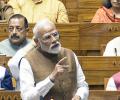
What was the aim of Operation Sindoor? Why was the operation halted so soon? asks Lieutenant General Prakash Katoch (retd).

Congress leader Rahul Gandhi visited Poonch in Jammu and Kashmir, offering condolences to families affected by cross-border shelling and encouraging students who lost two classmates to the violence. During an hour-long visit, Gandhi met with students at the convent school that lost the twins, and visited families whose homes were damaged in the shelling.
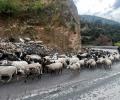
The edited sheep contains no foreign DNA, distinguishing it from transgenic organisms and paving the way for regulatory approval under India's evolving biotech policy framework.
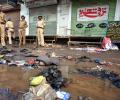
For the first time a serving army officer was accused of terrorism.

A deadly terror attack targeting tourists in Jammu and Kashmir's Pahalgam on Tuesday drew strong condemnation and outrage. 26 people, including two foreigners and two locals, were killed in the attack, which is the deadliest in the Valley since the Pulwama strike in 2019. Prime Minister Narendra Modi asserted that the perpetrators will not be spared and their evil agenda will never succeed. Opposition leaders demanded accountability, claiming the government's claims of normalcy in Kashmir have fallen flat.
India's sporting fraternity, including Olympic medalists Neeraj Chopra and PV Sindhu, expressed grief and condemnation over the deadly terrorist attack in Pahalgam, Kashmir.

Social media influencer Orhan Awatramani, known as Orry, and seven others were booked for allegedly consuming alcohol at a hotel in Katra, the base camp for the pilgrimage to Mata Vaishno Devi shrine. The FIR was registered for violating the law and hurting religious sentiments. The hotel reportedly prohibits alcohol and non-vegetarian food due to its proximity to the shrine.

In a heinous terror attack, two Indians were killed while one was abducted in the Dosso region of Niger, as noted by the Indian Embassy in Niger.
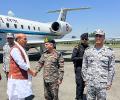
Defence Minister Rajnath Singh on Thursday questioned the safety of nuclear weapons in the hands of Pakistan, and said they should be taken under monitoring of the International Atomic Energy Agency.

A big question mark is on whether Shashi Tharoor, who had led the delegation to the US among other countries, will be picked as speaker by the Congress, as the seasoned Lok Sabha member's enthusiastic endorsement of the government's action following the terror attack has soured his ties with his party.
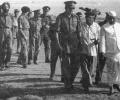
In what was perhaps the most critical meeting before full-scale war broke out, Shastri defined India's immediate war objectives to his defence minister, army, and air force chiefs: 'To defend against Pakistan's attempts to grab Kashmir by force and to make it abundantly clear that Pakistan would never be allowed to wrest Kashmir from India; To destroy the offensive power of Pakistan's armed forces...' A fascinating excerpt from Shiv Kunal Verma's must-read 1965: A Western Sunrise India's War With Pakistan.

People along the Line of Control and International Border in the Jammu region continue to live under the shadow of death, with unexploded mortar shells fired by Pakistani troops still embedded in farmlands and residential areas even though hostilities have stopped for nearly a week. IMAGE: Kindly note that this image has been posted for representational purposes only. Photograph: / Rediff.com Despite the May 10 understanding between India and Pakistan, locals describe the border areas as a 'death trap'. Sixty-two-year-old Balvinder Singh, who returned to his home in Pargwal sector on May 14, recounted a narrow escape. "Two shells exploded in our compound, damaging our house. Three more landed on our farmland. We were terrified and told our family to stay away from the fields until the Army could help," Singh told PTI. Army engineers later came to the village and safely defused the unexploded shells, bringing a temporary sense of relief. "Fear is writ large on the faces of people to these death traps in border hamlets", he said. Scenes of destruction are evident rooftops torn apart, broken houses, windows punctured by shrapnel, and carcasses of cattle lying in pools of blood. The acrid smell of gunpowder still lingers in the air. Sardar Gurmeet Singh faced a similar ordeal. His family could not re-enter their home as a live mortar shell had sunk into the compound in a village close to the International Border. "The army's bomb disposal squad removed it after four days, allowing us to finally enter, back home," he said. Indian Army engineers have launched a sweeping clearance operation across border districts, defusing over 80 unexploded shells in the past five days -- including 6 in Pargwal, 19 in Rajouri, 42 in Poonch, and 12 along the IB. "These shells, mostly 120 mm calibre, have a range of 15 to 30 km and pose a serious threat to both civilian and military targets," an Army officer said. "Many of them were fired by Pakistan during recent hostilities." On May 7, the Indian Army launched Operation Sindoor, conducting precision strikes on nine terror hubs in Pakistan and Pakistan-occupied Jammu and Kashmir (PoJK) in response to the April 22 terror attack in Pahalgam that killed 26 people, most of them tourists. The subsequent retaliation by Pakistan pushed the region to the brink of war. From 7 to 10 of May, 27 civilians were killed and over 70 injured in Pakistani shelling in the Jammu region. Farid Din Gujjar, a resident near the border, expressed fear about returning to his fields. "Several shells created deep craters in our paddy land. We cannot resume work until all unexploded ordnance is cleared. It's a death trap," he said. Army units, in coordination with Jammu and Kashmir Police, have evacuated high-risk zones and issued stern warnings to residents not to touch any suspicious objects or unexploded shells. In one major operation, 42 live shells were safely destroyed in the Poonch villages of Jhullas, Salotri, Dharati and Salani. "All safety protocols were followed. The shells posed a serious danger to local lives," an Army spokesperson said, calling the effort a 'continued commitment to protect civilians and restore normalcy'. Poonch saw the vast majority of deaths due to shelling. Security officials said that Pakistan used a mix of mortar shells, armed drones, and missiles during the shelling spree, specifically targeting civilian habitations and border towns in Jammu, Samba, Kathua, Rajouri, and Poonch. As clearance operations continue, the border residents are slowly returning to their homes, but with caution, fear, and lingering uncertainty about shelling that may yet happen in the future.
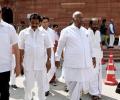
Leaders of 16 opposition parties demanded a special session of Parliament on Operation Sindoor in a letter to Prime Minister Narendra Modi as Indian National Developmental Inclusive Alliance (INDIA) parties held a meeting on the issue in the national capital on Tuesday.

Opposition parties have agreed to the agenda of taking up a special discussion on the Pahalgam terror attack and Operation Sindoor on Monday in Lok Sabha and the next day in Rajya Sabha, brightening up the prospect of normalcy returning to Parliament after the virtual washout of first-week proceedings.

A villager was killed and three others were injured in shelling by Pakistan in forward areas of Jammu and Kashmir's Poonch and Rajouri districts early Friday morning, prompting Army troops to retaliate. The shelling also caused significant damage to property, with many houses and hundreds of vehicles affected. The firing and shelling were directed at areas in Rajouri, Poonch, and Jammu districts, apart from Kashmir's Kupwara and Baramulla districts, overnight.

The revelation may have come late in the century but the Congress disclosed on Thursday, May 29, 2025, that the Indian Army conducted six surgical strikes against Pakistan during UPA-2, the Congress-led United Progressive Alliance government's second term in power.
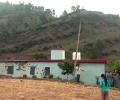
Heavy Pakistani shelling in the border district of Poonch in Jammu and Kashmir left nine people dead and 28 injured. The shelling, described by residents and officials as "barbaric and cowardly", started around 2 am, damaging dozens of residential houses, shops, vehicles, and heritage sites. The incident comes after India launched "Operation Sindoor" in retaliation to the April 22 Pahalgam terror attack. India condemned the act, calling it a cowardly attack on civilians, and reaffirmed that civilian safety remains its top priority.

Defying apprehensions of the horrific April 22 terror Pahalgam attack casting a shadow on the Amarnath Yatra this year, hundreds of pilgrims from various parts of the country lined up at the registration centre in Jammu on the first day.

India on Thursday night swiftly foiled Pakistan's attempts to hit various key Indian installations including military stations at Jammu, Pathankot and Udhampur with drones and missiles, the defence ministry said.
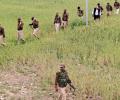
The bodies of a teenager and his two relatives were found near a waterfall in Jammu and Kashmir's Kathua district three days after they went missing. The Jammu and Kashmir Congress has demanded a high-level investigation into the incident. The police have ruled out any terror angle, but the exact cause of death is unknown and will be determined by a postmortem.

The Supreme Court on Thursday refused to examine a public interest litigation (PIL) seeking a judicial probe into the April 22 Pahalgam terror attack in which 26 people were killed.

'The way Helen ma'am grooves, she's so seductive.'
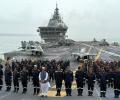
In an interaction with naval warriors on board aircraft carrier INS Vikrant off Goa, Singh sent a stern warning to Islamabad saying India will not hesitate to use the methods to deal with terrorism that Pakistan cannot even think of.

Defence Minister Rajnath Singh praised Jammu and Kashmir Chief Minister Omar Abdullah for his efforts to reduce the distance between the hearts of people in Jammu and Kashmir and Delhi. Singh asserted that the BJP government treats Delhi and Kashmir equally, emphasizing a commitment to bridge the gap between the regions. He criticized Pakistan occupied Kashmir (PoK) Prime Minister Chaudhry Anwarul Haq for his remarks against India and reiterated the importance of PoK as an integral part of Jammu and Kashmir.
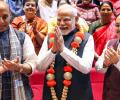
In his first address to National Democratic Alliance MPs in over a year, Prime Minister Narendra Modi on Tuesday emphasised its collective identity as a natural and organic alliance, asserting that its journey since its foundation in 1998 is dotted with successes and has many more achievements in store.

Amid a storm surrounding his collaboration with Pakistani actress Hania Aamir, singer-actor Diljit Dosanjh has taken to social media with a cryptic message.
Meanwhile, a precautionary blackout has been enforfced in the multiple areas amid the esclating tensions between India and Pakistan.

The highlight of Tuesday's debate on Operation Sindoor was the speech by Prime Minister Narendra Modi, with the rebuttal by Congress's Wayanad MP Priyanka Gandhi coming a close second.
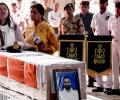
'Let his soul rest in peace...We should all be proud of him in every way. And we will make him proud in every way'
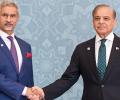
Addressing a special 'Youm-e-Tashakur' event at the Pakistan Monument in Islamabad, Shehbaz said that India and Pakistan fought three wars and got nothing.
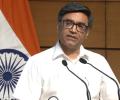
India carried out missile strikes on terror targets in Pakistan and Pakistan-Occupied Kashmir, including the Jaish-e-Mohammad stronghold of Bahawalpur and Lashkar-e-Taiba's base in Muridke, after the Pahalgam attack that killed 26 civilians. The Foreign Secretary said the actions were measured, non-escalatory, proportionate and responsible.

From the 30-share Sensex firms, Tata Motors, Bajaj Finance, Eternal, Adani Ports, Tata Steel, Titan, Mahindra & Mahindra and Power Grid were among the gainers. Asian Paints, Sun Pharma, ITC, Nestle, Reliance Industries and HCL Tech were among the laggards.
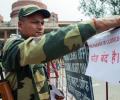
The Border Security Force on Friday said it has killed seven terrorists who were trying to infiltrate from across the India-Pakistan International Border in Jammu, and also destroyed a Rangers post.
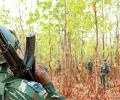
The Central Reserve Police Force (CRPF) has announced the formation of a special CoBRA battalion for counter-terrorist operations in Jammu and Kashmir. This decision comes 17 years after the jungle warfare unit was established to combat Naxal insurgency. The new battalion, directed by Union Home Minister Amit Shah, will be deployed in forested areas of Jammu and Kashmir, including the Jammu region, where recent terrorist incidents have occurred. CoBRA units are known for their specialized jungle warfare and guerilla tactics training, and the new battalion will be equipped with modern weaponry, communication, and surveillance equipment.
'Non-BJP state governments and their leaders, navigating today's political landscape, know well they have no clue what awaits around the corner.' 'The chances of charges pressed and oneself getting parked in custody play out on an uneven playing field,' points out Shyam G Menon.
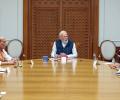
Shah briefed the prime minister on the attack and discussed the measures to be taken in its aftermath.

'Those who call for war from far-off places should realise the repercussions it has on the people who are actually affected.'
'If Pakistan has fired one bullet at us then we have to respond by firing 10 bullets at them. It is our right to do so.'

INDIA bloc parties are set to raise issues such as the Pahalgam attack, US President Trump's claims of brokering a ceasefire, and concerns over electoral roll revisions in Bihar during the Parliament's Monsoon session.
